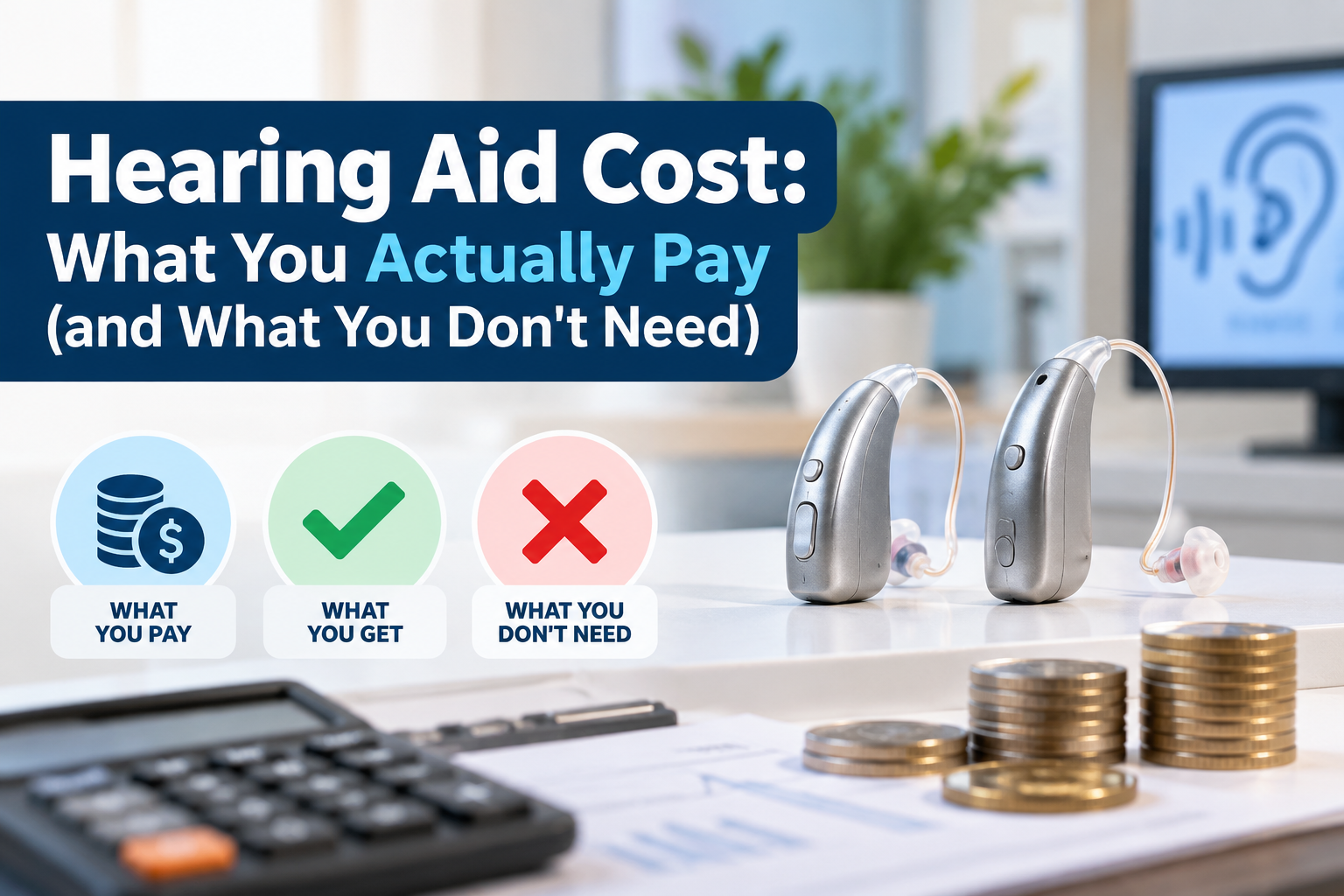
Hearing aid costs depend mostly on the technology level, the number of devices you need, and the professional services around them. Prices vary widely from clinic to clinic, which is why a single headline number rarely tells the whole story. The good news is that you do not have to pay for extras you will never use. When pricing is itemized, you can see exactly what you are paying for and choose only what fits your hearing and your budget.
If you have been shopping for hearing aids, you have probably noticed that nobody gives a straight answer to the simple question: how much do hearing aids cost? This guide explains what drives hearing aid prices, what is worth paying for, what is not, and how to compare quotes fairly. It is written for adults 55 and over, and for the family members who are helping them make this decision.
How Much Do Hearing Aids Cost? Why There Is No Single Price
Ask five clinics what hearing aids cost and you may get five very different answers. That is not because one is lying. It is because they are often not pricing the same thing.
Some clinics quote a single “package” price that includes the devices plus years of appointments, batteries, cleanings and other services. Others quote the device price alone. Some include a warranty and loss-and-damage coverage; others add it separately.
Here is a simple way to think about it. A hearing aid purchase has three parts:
- The devices (the technology you wear)
- The professional services (testing, fitting, programming, follow-up care)
- The extras (warranty extensions, accessories, supplies, service plans)
When you compare prices, make sure you are comparing all three parts, not just the headline number. You can see our services and pricing on our services and prices page.
What Drives Hearing Aid Prices?
1. Technology level
Hearing aids come in different technology tiers. In general, higher tiers offer more advanced sound processing, which can help in complex listening situations such as busy restaurants, group conversations and noisy environments.
Basic and mid-level devices can work very well for people whose daily life is quieter or more predictable. Premium devices may be a good value for people who are very active, work in noisy settings or attend many social events.
The key point: the most expensive device is not automatically the best choice for you. The right level depends on your hearing test results, your daily life and your goals.
2. Style and power
Hearing aids come in several styles, such as receiver-in-canal (RIC), behind-the-ear (BTE), in-the-ear (ITE) and completely-in-canal (CIC). Smaller, more discreet devices can cost more and are not suitable for every hearing loss or every set of dexterity needs. Your audiologist can explain which styles fit your ears and your hearing.
3. One device or two
Most people with hearing loss in both ears benefit from two hearing aids. Prices are often quoted per device, so always confirm whether a quote is for one aid or a pair. This single detail causes more confusion than almost anything else in hearing aid shopping.
4. Features you actually use
Common features that can affect price include:
- Rechargeable batteries
- Bluetooth streaming for phones and TV
- Smartphone app controls
- Directional microphones and noise management
- Tinnitus sound support
- Telecoil for looped venues
Each feature is useful for the right person. The question is whether you will use it. If you never stream audio, a model built around streaming may not be the best value for you.
5. Professional services
This is the part of the cost that people forget, and the part that matters most. A hearing aid is not an off-the-shelf product. Its performance depends on how well it is fitted and programmed to your hearing.
Professional services can include:
- A comprehensive hearing test see our complete guide to hearing tests
- Ear examination and, if needed, earwax removal
- Selecting the right device
- Fitting and programming
- Real-world adjustments after you start wearing them
- Follow-up visits, cleanings and repairs
Good fitting and follow-up care can make a more modest device perform better than a premium device that is poorly programmed.
6. Warranty and loss-and-damage coverage
Most hearing aids come with a manufacturer warranty, and some clinics offer loss-and-damage coverage. The length and terms vary. Ask what is included, what is optional, and what each option costs.
Bundled vs. Unbundled Hearing Aid Pricing
This is the most important concept in hearing aid pricing, and the reason many people feel they paid too much.
Bundled pricing
With bundled pricing, the devices and a set of services are sold together at one price. A bundle might include years of follow-up visits, cleanings, batteries or supplies.
Pros:
- One price, so it can be easy to understand at first
- Can be a good value if you will actually use every service included
Cons:
- You may pay for appointments and services you never use
- It can be hard to see what each part costs
- It makes comparing clinics difficult
Unbundled pricing
With unbundled pricing, the devices and services are priced separately, so you pay for the care you actually need.
Pros:
- Transparent: you can see what each item costs
- Easier to compare clinics fairly
- You are not paying for extras you do not need
Cons:
- You need to ask which services are available and what they cost
- Needs a clinic that is willing to itemize
An easy comparison: think about booking a flight. Many airlines let you add extras like additional baggage, extra legroom or a rental car, and most travelers do not need all of them. You choose what you need. Unbundled hearing care works in a similar way. We explain this more fully in bundled vs unbundled pricing.
Quest’s approach
Quest Audiology was founded on a simple idea: patients should only pay for what they need. In our own words, the goal is a more honest, transparent and simple approach to hearing care that makes your dollars go further. We offer the technology and care you need without automatically enrolling you in extended treatment plans full of extras. You can see our services and pricing details on our services and prices page.
Extras You May Not Need
Not everything on a quote is necessary for every person. Here are items worth asking about before you agree to anything:
- Long prepaid appointment packages. Ask whether you can pay per visit instead.
- Supplies you may never use. For example, a large supply of batteries for a rechargeable device.
- Premium features you will not use. Ask how each feature fits your daily life.
- Extended service plans. Ask what they cover and whether the standard warranty is enough for you.
- Accessories. Remote microphones, TV streamers and similar items are great for some people, but they are optional.
Some of these are worth it for some people. The point is that you should be the one to decide, with clear information.
Questions to Ask Before You Buy
Use this checklist at any clinic, including ours:
| Question | Why it matters |
| Is this price for one device or a pair? | Prices are often quoted per device |
| What is included in the price? | Compare the full package, not just the headline |
| Can I see an itemized quote? | Lets you see device cost vs service cost |
| Which follow-up visits are included, and which cost extra? | Avoid surprise charges |
| What is the trial or return period? | Protects you if the devices are not right |
| What does the warranty cover, and for how long? | Know your protection |
| Is loss-and-damage coverage included or optional? | Avoid unexpected replacement costs |
| What do repairs cost after the warranty ends? | Plan for the long term |
| Which brands and models do you carry, and why this one for me? | Confirms the recommendation fits your needs |
OTC vs. Prescription Hearing Aids
Over-the-counter (OTC) hearing aids are now available in the U.S. for adults with perceived mild to moderate hearing loss. [verify current FDA rules] They are generally less expensive upfront, and some people are happy with them.
However, there are trade-offs:
- OTC devices are meant for mild to moderate loss; they are not designed for everyone.
- There is typically less professional guidance on fitting and programming.
- Without a hearing test, it is hard to know whether your loss is mild to moderate, or whether something else, such as earwax or a medical condition, is involved.
If you are considering OTC, a hearing test first is a smart step, even if you decide to buy on your own. We break down the differences in OTC vs prescription hearing aids
Financing Hearing Aids
If the up-front cost is a concern, financing can spread it over time. Quest offers 0% interest financing. [confirm terms with Quest: length, credit requirements, any fees]
Before using any financing, ask:
- Is the interest truly 0%, or is it deferred interest that is charged if you miss a deadline?
- How long is the term, and what is the monthly payment?
- Is there a credit check?
- Are there fees for paying early?
Financing is a tool, not a reason to buy a more expensive device than you need. For more detail, see our article on hearing aid financing options
Insurance, Medicare and Other Coverage
Coverage for hearing aids is limited and varies a lot from plan to plan, so it pays to check before you buy.
- Original Medicare: Generally does not cover routine hearing aids or the exams to fit them. [verify current rules]
- Medicare Advantage plans: Some include hearing benefits, such as an allowance toward hearing aids. Benefits vary by plan and may require you to use certain providers. [verify current rules]
- Private or employer insurance: Some plans include a hearing aid benefit; many do not. Call your insurer and ask. [verify current rules]
- Medicaid: Coverage differs by state. [verify current New Hampshire rules]
- Veterans: Eligible veterans may be able to get hearing care through VA benefits. [verify current rules]
- HSA and FSA accounts: These may be usable for hearing aids and related costs, depending on your plan. [verify current rules]
Because rules change, always confirm your benefits directly with your plan or insurer before you make a decision.
How to Get the Best Value From Hearing Aids
- Start with a hearing test. You cannot choose the right device without knowing your hearing. Our complete guide to hearing tests explains what to expect.
- Match the technology to your life. Choose features you will actually use.
- Ask for an itemized quote. Separate the devices from the services.
- Compare like with like. One device vs a pair, and what is included.
- Plan for follow-up care. Good fitting and adjustments are what make hearing aids work.
- Take care of them. Regular cleaning and prompt repairs help protect your investment. Quest provides repairs for all major brands.
Ready to See What You Actually Need?
At Quest Audiology, we believe you should only pay for the care you need. We’d be glad to give you a clear, itemized picture of the options so you can make the choice that is right for you.
You can view our services and prices, schedule an appointment or call us at 978-915-7858.
Quest Audiology 166 S River Rd, Ste 110b, Bedford, NH Open Monday to Friday, 9:00 am to 5:00 pm
Frequently Asked Questions
How much do hearing aids cost?
Prices vary widely depending on technology level, style, whether you need one device or two, and what services are included. Ask any clinic for an itemized quote so you can see what you are paying for.
Why are hearing aids so expensive?
Hearing aids are small, sophisticated medical devices with advanced processing, and they require professional fitting and follow-up. In many clinics, the services are also built into the price. Unbundled pricing lets you see which part is the device and which is the care.
Does Medicare cover hearing aids?
Original Medicare generally does not cover routine hearing aids, though some Medicare Advantage plans offer hearing benefits. [verify current rules] Check your specific plan.
Are cheaper hearing aids worth it?
It depends on your hearing loss and your needs. Lower-priced devices can work well for some people, especially with a good fitting. A hearing test and professional advice can help you decide how much technology you really need.
Can I finance hearing aids?
Yes. Quest offers 0% interest financing.