- 603-824-3883
- 166 S River Rd ste 110b, Bedford, NH, USA

Hearing Aid Programming
Hearing Aid Programming In Milford, New Hampshire
A fair number of people around the Oval bought their hearing aids somewhere other than a local clinic: a warehouse club, an online fitting kit, a practice that has since closed its doors. Months or years later, the settings that felt fine at first start to feel wrong, and there is no one nearby to call. If that is why you are reading this from Milford, you are not in an unusual position. You are just looking for someone local who will work with the devices you already own.

What Programming Actually Adjusts
Hearing Aid Programming for Milford residents
Hearing aid programming is the adjustment work that happens after a device is fitted. It is not a new purchase and it is not a sales conversation. It is the process of matching what a hearing aid actually does to what your ears need right now, using your current hearing test results and a conversation about where the devices are falling short.
If you have spent years noticing that certain sounds are harder to place, that group conversations take more effort than they used to, or that a hearing aid you already own never quite got dialed in, this is the appointment that addresses that directly. No pressure to switch technology, no assumption that you need something new. Quest programs devices it did not sell as a matter of course, not as an exception.
This also matters for people who were fitted correctly at first. Hearing changes gradually, often without anyone noticing month to month, and a device programmed once and left alone stops matching the ear it was built for. Ongoing programming is part of caring for hearing over time, not a one-time event.
When You'd Need a Programming Adjustment
Sounds feel too sharp or too loud.
Common in the first few weeks as your brain relearns sounds it's been missing.
Speech is hard to follow in noise.
Restaurants, family gatherings, and car rides often need separate settings.
Your own voice sounds strange.
A quick adjustment usually resolves this without changing anything else.
You're hearing whistling or feedback.
Often a fit or seal issue that programming and a physical check can both address.
Your hearing has changed.
A new hearing test means the programming should be updated to match it.
You've moved into a new routine.
A new job, a new home, more time outdoors — all reasons settings might need to shift.
How a Programming Visit Works
What happens at your appointment
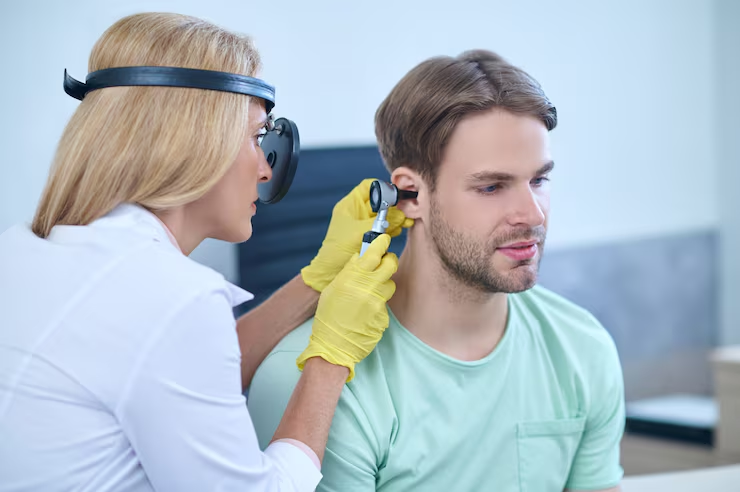
The appointment starts with a conversation, not a form. What are you noticing? Where is it hardest to hear? What have you already tried adjusting yourself? From there, current hearing levels are measured or reviewed, and your existing hearing aids are connected to programming software that reads their present settings.
From there, adjustments are made in real time while you listen and respond. Volume curves, background noise handling, and specific frequency ranges can all be changed independently, so if speech clarity is the issue but wind noise is fine, only the relevant setting moves. Most programming appointments run under an hour. You leave with devices adjusted to your current hearing and a clear sense of what changed and why, no jargon required.
The room itself looks more like a technology consultation than an exam. There is no waiting area full of forms to fill out before anyone will speak with you. That is a deliberate choice, not an accident.

Remote Programming Between Visits
The technology
Modern hearing technology has moved a long way past the analog aids many people picture when they think of hearing devices. Current hearing aids are small computers that process sound in real time, separate speech from background noise, and in many cases connect directly to a smartphone for streaming calls or audio.
What changed in the last several years is precision. Adjustments that used to be broad and generalized can now be made to narrow frequency bands, so a device can be tuned to the specific pattern of your hearing rather than a rough approximation of it. Rechargeable batteries have largely replaced disposables in newer models, and many devices can be fine-tuned remotely between in-person visits.
None of this is presented here as a pitch for one system over another. Quest does not push a particular manufacturer, because the point of this page is understanding what your options are and how they work, not steering you toward a specific product.

Programming Isn't a One-Time Event
Getting here from Milford
Quest Audiology’s office is in Milford, at 166 S River Rd Ste 110b. From central Milford, the drive out to Milford runs along Route 101A toward the South River Road corridor, generally about twenty to twenty-five minutes depending on traffic through the Route 101/101A interchange. Parking is on-site and free, with no garage or meter to deal with. There is no Quest office in Milford itself, so this Milford location is where every appointment happens.
Why Milford Residents Choose Quest Audiology for Programming
Your audiologist
Programming appointments at Quest are handled by {AUDIOLOGIST}, {CREDENTIALS}, who has spent {YEARS_IN_PRACTICE} working directly with patients on exactly this kind of ongoing adjustment. The approach here is less about running through a checklist and more about listening to what someone is actually experiencing before touching a single setting. You can read more about that background and approach at {BIO_URL}.
Your Audiologist
Common questions
Answers below cover the questions Milford residents ask most often about getting existing hearing aids adjusted locally.
Areas We Serve Near Milford, NH
Quest Audiology also provides hearing tests for patients throughout the greater Manchester area, including:
Manchester
Merrimack
Litchfield
Goffstown
Hooksett
Nashua
Londonderry
Amherst
Milford
FAQs
How often should hearing aids be reprogrammed?
Most patients need a few adjustments in the first months after fitting, then check-ins every six to twelve months, or sooner if hearing or lifestyle changes.
Does hearing aid programming cost extra?
Follow-up programming visits are included as part of your care. There’s no separate charge for coming back to adjust settings.
Can programming fix whistling or feedback?
Sometimes. Feedback is often a fit issue rather than a settings issue, so we check both during a programming visit.
Do I need a new hearing test before reprogramming?
Not always. Minor adjustments don’t require a new test, but if it’s been over a year, we’ll usually recommend one to make sure the programming still matches your hearing.
Can any audiologist reprogram hearing aids from another provider?
In most cases, yes, using manufacturer software. Bring your devices in and we’ll confirm compatibility during your visit.
Is remote programming as good as an in-person visit?
It works well for small tweaks. Anything involving real-ear verification or a physical fit check still needs an in-office appointment.
Ready to Schedule Your Hearing Aid Fitting in Milford, NH
Request a Consultation or Call Today at 603-824-3883 to schedule a programming visit. Prefer to start with a full check first? Schedule a Hearing Test.
Quest Audiology
166 S River Rd, Ste 110B
Milford, NH
603-824-3883